

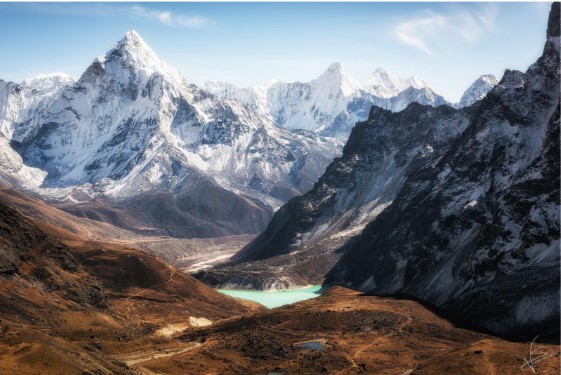
North of Kathmandu, beyond the chaotic traffic and dust of the valley, lies a hidden world carved by ice and guarded by towering peaks. The Langtang Trek leads into a glacial sanctuary that feels older than history itself—a high Himalayan valley where Buddhist prayer flags fade slowly in the wind, yak herds graze under hanging glaciers, and the echoes of tragedy and resilience live side by side.
Langtang does not shout for attention the way Everest or Annapurna do. There is no international airport, no famous base camp photo that everyone recognizes. Yet those who walk into this valley often leave with the quiet conviction that they have seen something more intimate, more human, and more honest than the “big name” treks. This is a place where nature, culture, and memory fuse into a single, powerful experience.
A Valley Marked by Legend and Earthquake
According to local legend, Langtang was discovered by accident. A herder chasing a lost yak followed it into an unknown valley and found a world so beautiful that people chose to stay forever. The name Langtang is often said to come from Tibetan syllables for “yak” and “to follow”—a reminder that sometimes, the greatest journeys begin with getting lost.
In modern times, Langtang is known not just for its beauty, but for its pain. On 25 April 2015, a massive earthquake shook Nepal. High above Langtang Village, snow and ice broke free from the flanks of Langtang Lirung. Within seconds, a combination of avalanche and air blast wiped out the village, burying homes, lodges, and lives under millions of tons of rock and ice. Entire families disappeared. Foreign trekkers, guides, lodge owners—gone in a single moment.
Today, a new Langtang Village stands close to the site, rebuilt by survivors who chose not to abandon the valley. As you walk past memorial walls and scattered boulders, you are reminded that this is not a fantasy landscape. It is a real place where people laughed, worked, prayed, grieved—and decided to start again. Trekking in Langtang is not just tourism; it is a quiet acknowledgment of that courage.
Landscapes Where Forests Give Way to Ice
The Langtang trek offers one of the most dramatic altitude gradients in Nepal over a relatively short horizontal distance. You feel every shift—not just in your lungs, but in the textures and colors around you.
From the trailhead at Syabrubesi, the path follows the Langtang Khola, a glacial river that hammers through boulder fields and narrow gorges. The lower valley is cloaked in dense forest: oak, maple, hemlock, and bamboo weave a green ceiling overhead. During spring, rhododendrons erupt in red and pink, painting the hillsides in fire. Langurs leap through branches, and if you are exceptionally lucky, you might glimpse the shy red panda slipping between mossy trunks.
As you climb toward Lama Hotel and Ghodatabela, the valley tightens. The river’s voice grows louder, and the air cools. Trees thin, replaced by birch and scrub. Above you, cliffs rise like fortress walls, streaked with waterfalls and shadow.
Beyond the rebuilt Langtang Village area, the valley suddenly exhales. The walls pull back, and you step into a broad, U-shaped glacial basin. Stone-walled fields, yak pastures, and scattered mani stones appear. The ground feels older, more exposed, as though the earth itself has shrugged off its vegetation to reveal bone and ice. Now the mountains are no longer distant—they loom directly above you.
At Kyanjin Gompa, the spiritual and geographical heart of the trek, the valley reaches its culmination. Glaciers cling to ridges. Seracs hang above dark rock. Peaks like Langtang Lirung, Gang Chenpo, Dorje Lakpa, Yala Peak and others encircle the settlement, forming a jagged amphitheater of snow and stone.
Kyanjin Gompa: Where Mountains and Mantras Meet
Kyanjin Gompa is not simply a trekking stop; it is a small world in itself. A monastery crowns a rise above stone houses and simple lodges. Butter lamps flicker inside, casting gold light on prayer wheels and faded thangkas. Outside, yaks shuffle past, bells clanking rhythmically. A small cheese factory, built with Swiss support decades ago, continues to produce the distinctive local yak cheese that has become a quiet symbol of the valley’s economy.
From here, the trek changes character. You are no longer just moving forward; you are moving upward.
- Kyanjin Ri (approximately 4,350–4,600 m) rises steeply above the village, a shoulder of rock from which you can watch sunrise bleed slowly over the peaks, revealing the architecture of glaciers in cold, precise light.
- Tsergo Ri (around 4,984–5,000+ m) demands a longer, harsher ascent, often over loose rock and lingering snow. The reward is a 360-degree sweep of summits and icefields that feels almost unreal in its scale.
Up here, the valley below looks fragile—a thin green thread of life woven between sheer, indifferent mountains.
Tamang and Tibetan Roots: Culture in the High Valley
Langtang is not just a trek through scenery. It is a walk through a living cultural tapestry dominated by Tamang and Tibetan-descended communities. Their faces carry the weather of high-altitude life; their architecture, rituals, and language echo across the border into Tibet.
On the trail you pass:
- Mani walls carved with mantras in Tibetan script—always keep them on your right as you pass, out of respect.
- Chortens and stupas standing at village edges or ridgeline passes, splashed with whitewash and crowned with prayer flags.
- Prayer wheels built into house walls and village gateways, turning slowly under the hands of locals and trekkers alike.
Inside kitchen-lodges, the air smells of woodsmoke, butter tea, and boiling rice. Elderly women spin wool while children chase chickens outside. Conversations slide between Nepali, Tamang, and Tibetan. The outside world comes in through radios and mobile phones, but life still follows the cycle of planting, grazing, harvest, and winter.
Unlike some more commercialized trek routes, Langtang retains a sense that you are moving through actual homes, not just a corridor built for tourists. That comes with responsibility—to be quiet when it is late, modest in dress near monasteries, and generous where it counts: in patience, in listening, and in support.
Trekking Realities: Route, Difficulty, and Acclimatization
On paper, the Langtang Trek is often labeled as moderate. In practice, it is as demanding as you decide to make it.
A classic route looks like this:
- Drive from Kathmandu to Syabrubesi
- Trek Syabrubesi → Lama Hotel → Ghodatabela → Langtang Village area → Kyanjin Gompa
- Spend one or two days climbing viewpoints such as Kyanjin Ri or Tsergo Ri
- Retrace steps back down the valley
Daily walking ranges from 5 to 7 hours, with gradual altitude gain. While the maximum normal sleeping altitude (around 3,870 m at Kyanjin Gompa) is lower than many Himalayan treks, optional side trips push close to 5,000 m. That makes altitude awareness non-negotiable.
- Ascend gradually; don’t try to rush from low valley to high viewpoints in a single leap.
- Take rest days seriously—an extra night in Kyanjin Gompa can mean the difference between a joyful climb and a brutal slog.
- Learn the symptoms of acute mountain sickness and respect them. The mountains will not move; you can always come back.
Physically, anyone with reasonable fitness, some hiking experience, and the humility to walk at the valley’s pace rather than their ego’s can complete the Langtang trek.
When to Go and What It Really Feels Like
The valley is technically accessible most of the year, but it reveals very different faces with the seasons:
- Spring (March–May): Rhododendrons set the lower forests on fire, and the snowline recedes. The air is softer, but afternoons can cloud over.
- Autumn (September–November): The monsoon’s dust is washed away, leaving the mountains etched sharply against a deep blue sky. Nights grow cold; mornings can feel almost surgically clear.
- Winter: The valley closes in. Snow makes higher sections icy
